Key Takeaways
- Sizing is the biggest online fit problem: There is no universal sizing standard, so labels like S or M vary widely by brand and drive a large share of apparel returns.
- Measurements beat size labels every time: Shoppers who know their bust, waist, hips, and inseam can compare against size charts and make far more accurate choices.
- Fit style matters as much as size: Relaxed, slim, oversized, and stretch fits all change how a garment feels, even if the measurements look similar.
- Static size charts are no longer enough: AI tools like virtual try-ons, fit quizzes, and conversational guidance help shoppers visualize fit and reduce uncertainty.
- Better sizing guidance means better business results: Clear, personalized fit support increases shopper confidence, improves conversion, and lowers size-related returns.
Size labels like S, M, and XL often provide little real guidance when shopping for clothing online. Even with a sizing chart on the product page, shoppers frequently receive items that don’t fit as expected. The core issue is simple: there is no universal sizing standard. Each brand defines its own measurements, which means the same size can feel drastically different from one retailer to the next.
This lack of consistency has real consequences for both shoppers and brands. Missed sales, higher return rates, and growing frustration are common outcomes. In fact, a 2025 Rithum survey of 6,000 consumers found that 61% cited poor fit as a reason for returning apparel.
The good news is that this problem is no longer unsolvable. AI-powered sizing tools, such as size recommendation engines, virtual try-ons, and interactive fit guidance, now use body data, garment measurements, and shopping behavior to predict real-world fit far more accurately than static size charts. The result is greater purchase confidence, fewer returns, and a smoother experience for everyone involved.
Why Accurate Sizing Matters When Shopping Online
Accurate sizing is critical when shopping for clothing online, where customers can’t physically try items before purchasing. Getting the size right improves comfort and appearance, while also reducing the likelihood of returns, exchanges, and post-purchase frustration.
- Eliminates the need for product return or exchange, saving unnecessary shipping fees.
- Enhances customer satisfaction after purchase.
- Perfectly fitted clothes ensure comfort and improve the overall look.
Useful Sizing References
Online apparel sizing relies on several reference points that help shoppers translate product information into real-world fit. Understanding these sizing references makes it easier to compare options across brands and choose the most suitable size with confidence, especially when virtual try-on is available to visually confirm how a size may fit before purchase.
- Size Charts: Most apparel brands include a size chart on each product page, allowing you to compare sizes (e.g., Small, Medium, Large) and see which fits you by measuring your waist, hips, and bust.
- Body Measurements: Your own body measurements help you find your size when shopping online. You can use a measuring tape and take measurements of your chest, waist, hips, and desired sleeve length to help you choose your clothes.
- Fit Guides: Many brands also include fit guidance to explain how a garment is intended to be worn on the body. For example, a slim-fit shirt is designed to sit closer to the body, while a relaxed or loose fit offers more room through the chest and waist. Understanding these distinctions helps shoppers decide whether to size up or down based on their comfort preferences and styling goals.
- Virtual Fitting Rooms: Brands like ASOS, Macy's, and Walmart offer AI-powered fitting rooms where users can try apparel virtually, often as part of a broader virtual try-on experience. Users may be required to select a body type or enter their body measurements to use this feature.
Body Measurements vs. Standard Sizes
Body measurements and standard apparel sizes could be confusing to many. Here are the most common measurements from XXS to XXL. However, it’s important to note that apparel sizing varies by brand and the origin standards they follow.
| Size | Bust / Chest (cm) | Waist (cm) | Hips (cm) | Shoulder (cm) |
|---|---|---|---|---|
| XXS | 78-81 | 60-63 | 85-88 | 36-37 |
| XS | 82-85 | 64-67 | 89-92 | 37-38 |
| S | 86-89 | 68-71 | 93-96 | 38-39 |
| M | 90-94 | 72-75 | 97-100 | 39-40 |
| L | 95-99 | 76-79 | 101-104 | 40-41 |
| XL | 100-104 | 80-84 | 105-108 | 41-42 |
| XXL | 105-109 | 85-89 | 109-112 | 42-43 |
How to Measure Properly When Buying Clothing Online
Knowing your correct body measurements is one of the most reliable ways to improve fit when shopping online. Taking accurate measurements allows you to compare them directly against brand size charts and make more informed sizing decisions.
- Bust/Chest: Take a measuring tape and wrap it around the fullest part of your chest by keeping your arms down, or parallel to the tape. The tape must level across the back and chest. If needed, have someone help you to make sure the tape doesn't twist. Also, avoid holding your breath. Finally, check the measurements in the mirror.
- Waist: For this, wrap the tape around the narrowest part of the torso, just above the belly button. Make sure you do not suck in your stomach or hold your breath. Like the chest, the tape needs to stay straight across your waist.
- Hips: With a relaxed posture, wrap the tape around the fullest part of your hips without twisting it. Also, make sure you do not wrap it too tightly, yet it still needs to stay snug.
- Inseam: Instead of measuring your body, it’s easier to measure a pair of well-fitting pants. Place the pants on a flat surface and measure from the crotch seam to the bottom hem of the pants with a tape measure.
- Shoulder: Place your tape on the outermost point of one shoulder and measure to the other point of the shoulder across the back to get your shoulder width. Measuring the back on your own may be difficult, so have someone help you out.
- Sleeves: Place the tape at the center of your back and measure to the wrist bone; follow the natural curves of the elbow.
Sizing Guides by Clothing Type
| Clothing Type | Key Sizing Considerations |
|---|---|
| Tops & Blouses | Bust/chest, sleeve length, sleeve hem, and shoulder width. Fit can vary (loose, fitted, etc.). |
| Pants & Jeans | Inseam length for the (vertical) fit of the pants. Consider rise (high-rise, mid-rise, low-rise). |
| Dresses | Key measurements: Bust, waist, and hipAlso consider knee-length and fit type (A-line, bodycon, etc.). |
| Outerwear | Chest and shoulder measurements are crucial. Sleeve length is important for jackets and coats. Consider fit for layering. |
| Activewear & Swimwear | Stretchy materials allow more flexibility in sizing. Focus on bust, waist, and hip measurements. |
Fit Styles to Consider Before Choosing a Size
How much the garment size will deviate from your actual body measurements depends on the style of your chosen design. Here’s how different fit styles influence the sizes.
- Relaxed Fit: Requires extra room around the chest, hips, and waist. Actual measurements of the clothes depend on the looseness and comfort you seek.
- Slim Fit: Usually closer to your actual body measurements than regular/relaxed fit clothes. Also, the size depends on the design; a clothing item may have a snug fit around the bust with loose-fitting sleeves.
- Oversized Fit: Typically drapes loosely over the body and offers more room around the chest, waist, and arms. However, the size varies depending on the individual design.
- Adjustable or Stretch Fits: Some clothes are made of stretch fabrics like spandex or elastane. These may come in flexible/adjustable sizes that fit most body types.
How to Read and Compare Size Charts
The next step - after measuring your own body - is to figure out the size charts. Here are easy steps to do it.
Understanding Brand Variations
Never assume that a Medium or Large is consistent across brands. Sizes differ by brand, and in some cases, what’s labeled a Medium in one brand could fit like a Small or Large in another. That’s why it’s important to check the size charts and fit guides to figure out the right size.
Letter vs. Number Sizing
Not all brands use letter sizing (XS, S, M, L, XL); some may use number sizing as well. For example, 0, 2, 4, 6, 8 for women and 28, 30, 32, 34 for men. The standards vary depending on each region.
Global Size Conversions
US sizes are typically larger than UK sizes. You may find that a US size 8 is the same as a UK size 10. On the other hand, European sizes typically range from 34 to 50 for women and 44 to 60 for men. You can look up a conversion size guide or the country of origin to determine the sizing standard.
When to Pick Between Two Sizes
It’s very common to sometimes fall between two sizes. Let’s say Size M and L, both seem to fit you right. In that case, consider these to decide:
- Check whether it’s a relaxed fit or a slim fit, and also consider your preference. Let’s say you want more comfort in a slim-fit dress, then you may go for the larger option.
- Study the reviews to check if there are any suggestions for sizing up or down.
- If you’re concerned that the fabric will shrink after washing, select a larger size. Similarly, for stretchy fabric, select the smaller size.
Tips for Choosing the Right Size When Shopping Online
Even with size charts and measurements, choosing the right size online isn’t always straightforward. Following a few best practices can help reduce guesswork and increase the chances of finding clothing that fits well on the first try:
- If you’re a beginner in online clothing shopping, simply start with trusted brands or brands you have previously purchased from for accurate sizing.
- Choose brands that offer flexible return and exchange policies. If the size does not fit, you may return it and get the right size in exchange.
- To quickly find your size, consider keeping a personal fit log with your bust, waist, hips, inseam, and other measurements. This will work as a reference point while shopping online.
- If choosing the sizes seems like a hassle or no clothes fit you perfectly, consider buying clothes made of stretch fabrics like spandex, elastane, or jersey that will adjust to your body type.
Common Sizing Mistakes to Avoid
Many sizing issues stem from small but common mistakes shoppers make when buying clothing online. Being aware of these pitfalls can help you avoid poor fit, unnecessary returns, and wasted time.
| Sizing Mistake | Why It's a Mistake |
|---|---|
| Assuming Consistency Across Brands and Regions | Sizes vary by brand and region. A Medium in one country may fit differently elsewhere. |
| Relying on Historical Size Rather Than Current Measurements | Body sizes change over time. Old sizes may no longer fit accurately. |
| Ignoring Fabric Content and Stretch Percentage | Fabric composition affects how an item fits and stretches. For example, cotton may shrink, while spandex offers flexibility. |
| Failing to Account for Garment Shrinkage and Care Instructions | Some fabrics shrink after washing or drying. Going for the exact fitting may make them unusable. |
| Neglecting to Check the Model's Height and Size Reference | The fit on the model may look different based on their height and body type. Without reference, it’s hard to predict how it will look on you. |
Challenges Brands Face with Online Sizing
For apparel brands, online sizing is more than a customer experience issue - it’s a business challenge. When shoppers struggle to find the right fit, brands face higher return rates, lower conversion, and reduced confidence in their product listings.
- High Return Rates from Size Issues: Customers often return clothing because it doesn't fit them well. As a result, brands face high return rates and increased operational and margin pressure.
- Inconsistent Brand Sizing Standards: Inconsistency in sizing often leaves customers confused, leading to cart abandonment and returns.
- Low Shopper Confidence in Fit: Customers often hesitate to buy because they're unsure of the size, which can lead to poor conversion rates.
- Lack of Real-Time, Personalized Assistance: When shopping online, most customers do not receive the tailored, instant guidance they need to select the right size. This is another key reason brands miss some sales.
Leveraging AI and Virtual Try-On for Sizing Confidence
The age-old size charts are now getting replaced by AI chatbots and virtual try-ons. From Ralph Lauren to Walmart, brands are widely incorporating innovative AI applications in sizing suggestions.
How Visualizations (3D/Video) Replace Manual Measurement
With 3D avatars and virtual try-on technologies, brands are letting users visualize how a garment looks virtually. Walmart’s virtual try-on offers 100+ virtual models across different body types, skin tones, and hair for customers to choose from. The customer can also upload their photos for the AI to scan and create a tailored model. For example, Culture Kings is using a virtual try-on tool on every PDP, allowing shoppers to upload their image and receive a photo of how the item looks on them.
The Role of Conversational AI in Sizing Recommendations
Conversational AI chatbots typically interact with shoppers, ask about fit preferences and sizing context, and guide them toward relevant products or size guidance. Ralph Lauren introduced an AI-powered chatbot, Ask Ralph, that converses with customers like a personal stylist. Chatbots like this ask relevant questions to suggest styling tips, recommend outfits, and guide them through sizing decisions.
How Tolstoy Helps Shoppers Choose the Right Size Online
With Tolstoy, brands can get creative in helping shoppers navigate fit and sizing decisions in different ways:
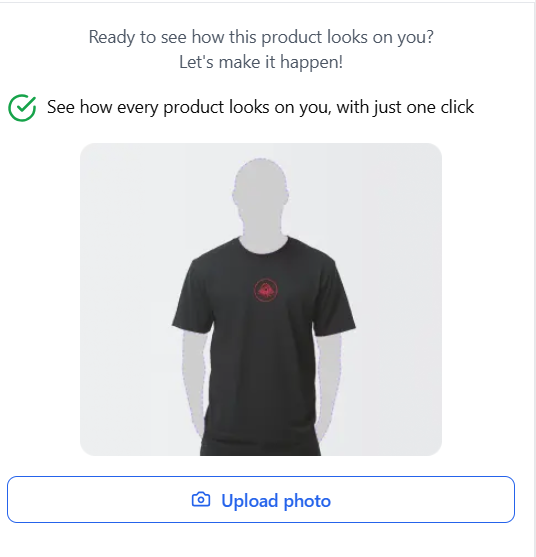
- Seamless Virtual Try-On and Sizing Recommendations: Tolstoy’s AI Sales Agent lets customers visualize how products will look on them with realistic virtual try-ons. Its virtual try-on tool can be added to your product pages, helping users find their sizes effortlessly, without needing to leave the page.
The user can upload images to see how the product looks on them virtually. They also receive highly accurate sizing recommendations when they enter their measurements. The tool analyzes the measurements a shopper enters and compares them with the product’s sizing details, suggesting the ideal size in seconds.
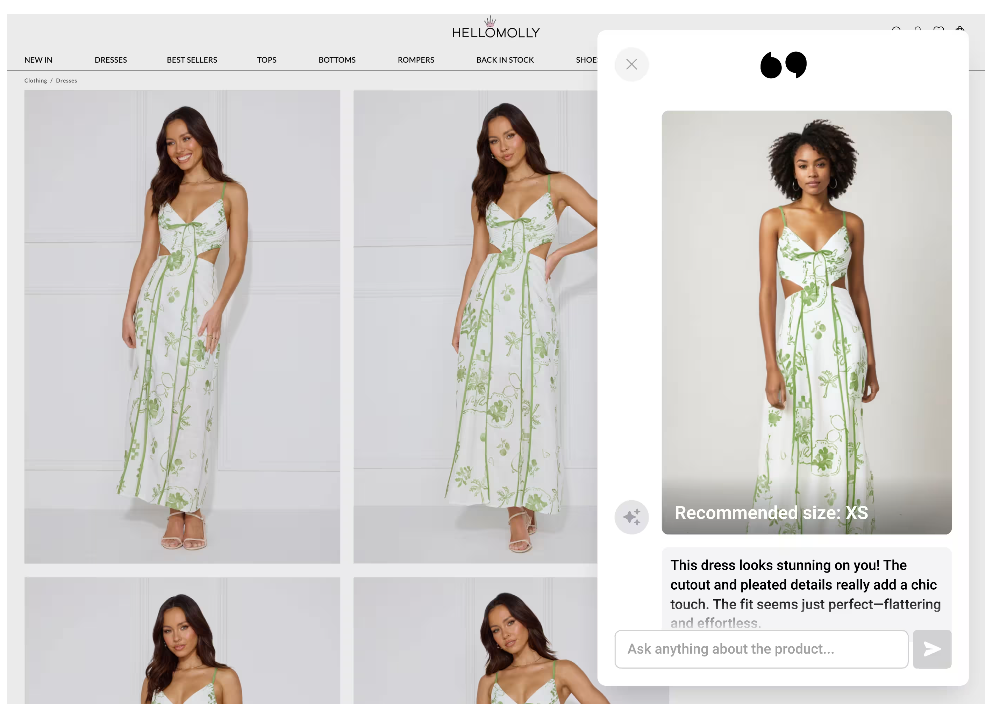
- Personalized Suggestions Based on Shopper Inputs: Tolstoy’s chatbot can monitor and analyze user behaviors and intent to offer suitable product
recommendations. It can offer highly personalized suggestions like a real salesperson, and even answer questions about dimensions and sizes, making nearly zero errors.
Reducing Size-Related Returns for Brands
These approaches help brands reduce sizing uncertainty and improve shopper confidence. As a result, brands can work toward lowering size-related returns and supporting stronger PDP conversion performance.
Conclusion
Buying clothing in the wrong size often leads to poor fit, unnecessary returns, and added costs for both shoppers and brands. While traditional size charts still play a role, they are no longer enough to address the complexity of online apparel sizing.
Brands that invest in clearer sizing guidance and modern tools, such as AI-powered virtual try-on and chatbot experiences, can significantly improve shopper confidence and reduce fit-related friction. By helping customers understand how a product will actually fit before they buy, retailers create a more reliable, engaging, and conversion-friendly shopping experience.
Frequently asked questions
How can shoppers choose the right size when brands have inconsistent sizing?
If you think the brand-provided sizing is incorrect, you can: Read through reviews for fit notes like "runs small" or "oversized”. Check if there are any return or exchange options in case the size doesn't fit.
How can Tolstoy help shoppers pick the perfect size online?
Tolstoy offers a seamless option to help shoppers pick the perfect size online. A virtual try-on tool can be implemented on each product page to deliver sizing suggestions based on a shopper’s photo and measurement details. The AI Sales Agent Chatbot provides size recommendations based on the shopper’s given information and queries. The chatbot also allows users to try on one or many products virtually.
What should shoppers do if a size chart provides only minimal information?
If the size chart is not easy to follow, consider: Reading reviews to get suggestions Contact customer support Try to find which size chart standard the brand offers, and look into the details. Make sure they have a return/exchange policy if the size doesn't fit.
Does the tool save shopper data?
Yes, shoppers log in to the virtual try-on tool, entering their measurements once, and it's saved. This information is collected as zero-party data, meaning shoppers consensually share it during the experience. The saved data can be used to personalize product recommendations and improve the shopping experience, which can support higher conversion and sales over time.
Is this connected to other customers' experiences?
Yes. Integrates with ecommerce platforms like Shopify to support on-site shopping experiences. Connects with customer communication and CRM tools such as Gorgias and Klaviyo. Supports operational workflows and reporting through integrations with Slack, Google Sheets, and Tapcart.
How is the image generated?
The images are AI-generated with the latest and most accurate AI models available. Brands can also choose which model the tool will use. Images are generated in Tolstoy’s AI Studio using advanced AI models and a chat-based prompt interface. The system pulls product data and brand styling from connected ecommerce catalogs to customize outputs. Templates and bulk generation produce PDP-ready images at scale without photoshoots.
Create with Tolstoy
Put these ideas into practice
Turn your product ideas into AI images, videos, and shopping experiences.