
From Amazon to Spotify, big brands are embracing AI tools to personalize their marketing campaigns and shopping experiences. Etsy analyzes users’ browsing history, purchases, and favorite items to deliver an advanced AI-powered search personalization. Netflix also shows users’ favorite content based on viewing habits, ratings, and watch times.
A McKinsey 2025 study shows that 90% of business leaders expect AI to drive revenue growth, while 92% say they will increase AI investments over the next 3 years. Moreover, about 55% of businesses plan to increase their current investments in AI by at least 10%.
All these signs indicate how AI tools are reshaping e-commerce. This 2026 guide compares the jobs each platform is built to do, so teams can choose a focused stack instead of buying several overlapping AI subscriptions.
Quick Answer: Build an AI Stack Around the Job
| If your bottleneck is… | Start with… | Measure… |
|---|---|---|
| Producing product images, videos, and ads | A catalog-aware content platform such as Tolstoy AI Studio | Approved assets per SKU, time to publish, cost per usable asset |
| On-site product discovery and purchase questions | An ecommerce sales assistant; use our AI chatbot comparison to separate sales tools from support bots | Assisted conversion, product clicks, add-to-cart rate, unresolved questions |
| Publishing UGC and product video on storefronts | A shoppable video platform connected to the catalog | Video engagement, product clicks, assisted revenue, page performance |
| Email and lifecycle automation | A marketing automation platform with first-party ecommerce events | Incremental revenue, repeat purchase, unsubscribe rate |
| Support deflection and order operations | A helpdesk AI agent with verified catalog and order access | Resolution rate, escalation rate, CSAT, incorrect-action rate |
Do not evaluate all five categories with one generic “AI ROI” number. Give each tool one owner, one production workflow, and one outcome metric. If two products own the same job, consolidate before adding another platform.
What Are E-Commerce AI Tools?
E-commerce AI tools are specifically designed to help e-commerce businesses offer better services and drive revenue by leveraging artificial intelligence and machine learning. These tools can automate many processes and implement personalization across sales channels. Website personalization, chatbots, self-checkout systems, personalized recommendations, sales forecasting, and analytics – AI tools have diverse use cases in the e-commerce sector.
Types of E-Commerce AI Tools
AI is used to create a wide range of e-commerce solutions. AI-powered tools are typically designed to automate shopping processes, and enhance search experiences, product discovery, and much more.
| Type of E-Commerce AI Tool | Description |
|---|---|
| Product Recommendation Engines | Analyzes customer data, including past purchases, browsing history, and demographic information, to create personalized product recommendations tailored to each customer's preferences. |
| AI Chatbots and Virtual Assistants | Uses natural language processing (NLP) and machine learning to understand customer queries and answer FAQs, route tickets, and often suggest products or upsell in chat. |
| Dynamic Pricing Platforms | Tracks demand, sales, and competitor prices and automatically adjusts your prices based on the retrieved data. |
| Visual Search and Discovery Tools | Allows customers to search with images instead of text. Makes product discovery effortless and improves conversions. |
| AI Marketing & Content Automation | AI-powered tools analyze your brand voice and target audience to generate product descriptions, reviews, headlines, and more, and automate marketing processes across websites, social media, and email. |
| Customer Engagement and Retention Tools | Learn from real customer behavior and sentiment. Make timely, tailored decisions to engage customers, reduce churn, and increase loyalty. Examples include AI-powered churn alerts, upsells, and win-back campaigns. |
| Visual representation / AI photos and videos | Used for generating professional images and videos in bulk and virtual try-ons. Typically, the AI creates visual content based on prompts. |
How E-Commerce AI Tools Work
To integrate AI tools into your e-commerce processes, it’s important to understand how they work in sequence. Here’s how an e-commerce AI tool typically works:
1. Collecting and Analyzing Customer Data
Collects data from various sources, including websites, apps, transaction logs, and devices. AI tools can also access external sources like social media signals and reviews to fetch data. AI tools recognize patterns in consumer behavior to create actionable insights.
2. Training AI Models for Decision-Making
It’s important to train AI models by feeding them the necessary data. This AI model training teaches the AI to make accurate predictions and recommendations.
3. Integrating AI Tools with E-Commerce Platforms
The trained and tested models are ready for integration into e-commerce platforms, such as websites, mobile apps, ERP systems, and other channels.
4. Continuous Learning for Better Performance
Advanced AI tools are designed to learn continuously. E-commerce AI tools typically improve by analyzing outcomes, customer feedback, and operational data. They get better at predicting future events and patterns, delivering more accurate responses.
Benefits of Using E-Commerce AI Tools
E-commerce AI tools are typically designed to handle specific challenges or use cases. However, below are the most common benefits that an e-commerce AI tool offers.
- Higher Conversion Rates: AI tools are great for recommending products that are most likely to appeal to customers based on their unique past behavior and preferences. AI-powered personalization can increase conversion rates by 20-30%. Plus, AI tools can improve customer experience and drive higher conversions by offering on-site visual try-ons, personalized recommendations, advanced search options, and self-checkouts.
- Improved Customer Retention: AI tools help e-commerce companies design personalized campaigns and experiences tailored to individual behavior, preferences, and timing. And this, in turn, improves customer retention. AI-powered loyalty programs can increase customer retention by 20%. Moreover, businesses using AI analytics to predict customer behavior also see a 30% increase in customer retention.
- Faster Product Discovery: A Salesforce study reveals that 39% of shoppers rely on AI for product inspiration and discovery. Among them, about 50% are Gen Z consumers, indicating that the use of AI for product discovery is increasing among younger generations. Soon, we may see many more people rely on AI tools to discover and research products. Brands can integrate chatbots, virtual try-ons, and other shopping assistants to help visitors in faster product discovery.
- Greater Marketing Efficiency: A recent report by CoSchedule shows that 83% of marketers who relied on AI tools increased productivity, where AI saves them over 5 hours a week. Marketers use AI to automate tasks, generate content, collect insights, analyze data, and more.
Challenges of Using E-Commerce AI Tools
AI tools come with many advantages, but they also pose challenges that businesses must address, such as the following:
| Challenges | Description |
|---|---|
| Data Quality and Integration Issues | Not every ecosystem is AI-ready. Integrating data with your current tools, databases, or workflows can become complex and time-consuming. Plus, clean and accurate data, along with strong data privacy, clear access control, and ownership, are also necessary for accurate decision-making. |
| Over-Personalization and Brand Consistency | AI personalization can also diverge from brand standards, making it hard to maintain a consistent message and identity across multiple channels. Over-personalization could damage users’ trust in a brand and create fatigue. |
| Rising Costs and Resource Demands | Requires high upfront investments in skilled professionals, software, and hardware, and ongoing expenses for model updates, data storage, and subscription fees. |
| Dependence on Accurate Attribution Models | AI tools highly depend on attribution models for decision-making. If the attribution models are flawed, the AI will deliver unreliable outcomes. |
Best Practices for Implementing E-Commerce AI Tools
- Define Clear Goals and KPIs: Set specific, measurable goals and KPIs such as conversion rate, cart abandonment rate, repeat‑customer rate, and average order value to measure your efforts.
- Choose Scalable and Integration-Ready Solutions: Select solutions that integrate with your CRM, inventory management, and other infrastructure. Your AI solutions should be scalable to handle your growing transaction volume and customer base.
- Select a Model Agnostic Platform: Choose AI platforms that can integrate and seamlessly work with multiple models and LLMs. This is because AI tech is consistently evolving, and your AI tools should easily switch between different solutions as needed.
- Test, Measure, and Refine Regularly: Follow the test (pilot), measure (evaluate), and refine (iterate) roadmap to improve the AI’s decision-making and outcomes.
- Maintain Human Oversight in AI Decisions: AI solutions may be designed to act and learn automatically, but still, human governance, such as audit for bias or error, or ensuring transparency in AI-driven decisions, is required to ensure safe, accurate AI usage.
- Keep Customer Experience at the Core: Your goal should always be to ensure a great customer experience, not to implement unnatural or slow AI-powered solutions.
Key Features to Look For in E-Commerce AI Tools
Your AI-powered solutions should have these key features to help you drive high conversion, using AI’s personalization and automation:
| Key Features to Look For | Description |
|---|---|
| Personalized Product Recommendations | Offers tailored product recommendations based on browsing history, past purchases, clicks, or other customer data. |
| AI-Driven Customer Support and Engagement | AI-powered chatbots, virtual assistants, or conversational agents to handle customer queries, product discovery, and abandoned carts. |
| Automated Marketing Campaigns | For automating marketing operations such as segmentation, email/SMS campaigns, ad-spend optimization, and content generation. |
| Customer Behavior Tracking and Insights | Tracks past customer behavior data and shows actionable insights. |
| Real-Time Experience Personalization | Shows tailored suggestions, website interface, and content based on past behavior and other consumer insights. |
Most Popular E-Commerce AI Tools
E-commerce brands can now choose from a wide variety of AI tools. Below, we compare five established options using their publicly documented product capabilities. This is a category and workflow comparison, not a claim that every output was hands-on tested.
1. Tolstoy
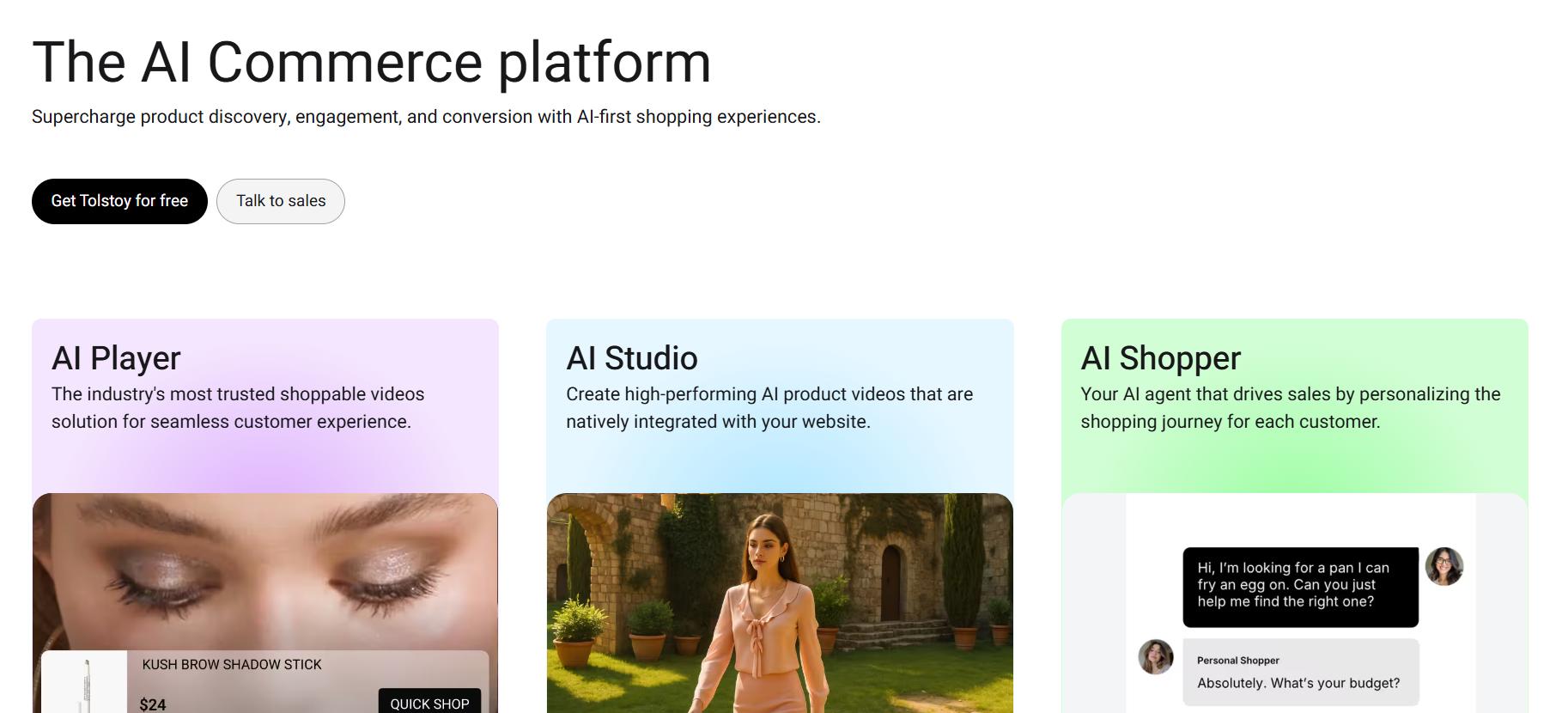
Tolstoy is an AI-commerce platform built to help e-commerce brands boost conversions and streamline content creation. Its core offering centers on creating and publishing shoppable videos, allowing brands to embed clickable, conversion-ready videos directly on their website, PDPs, emails, and other channels—whether sourced from social media, created in-house, or generated with AI.
With Tolstoy’s AI Studio, brands can automatically generate studio-quality product images and videos at scale. Merchants can produce on-brand, polished visuals simply by selecting one of hundreds of ready-made, e-commerce-specific templates or by chatting with the AI Creative Director agent. Tolstoy’s AI Studio eliminates the need for traditional photo shoots and video editing and replaces multiple subscriptions to separate AI generation tools.
Tolstoy also includes AI Sales Agent, an AI-powered sales assistant that functions as Virtual Try-On and a real-time product expert. It answers customer questions, provides accurate sizing recommendations, recommends relevant products, and helps drive purchases—bringing personalized, conversational shopping directly into the on-site experience. Teams evaluating AI commerce tools can also set up Tolstoy MCP with ChatGPT, Claude, Cursor, or Codex.
2. Jasper
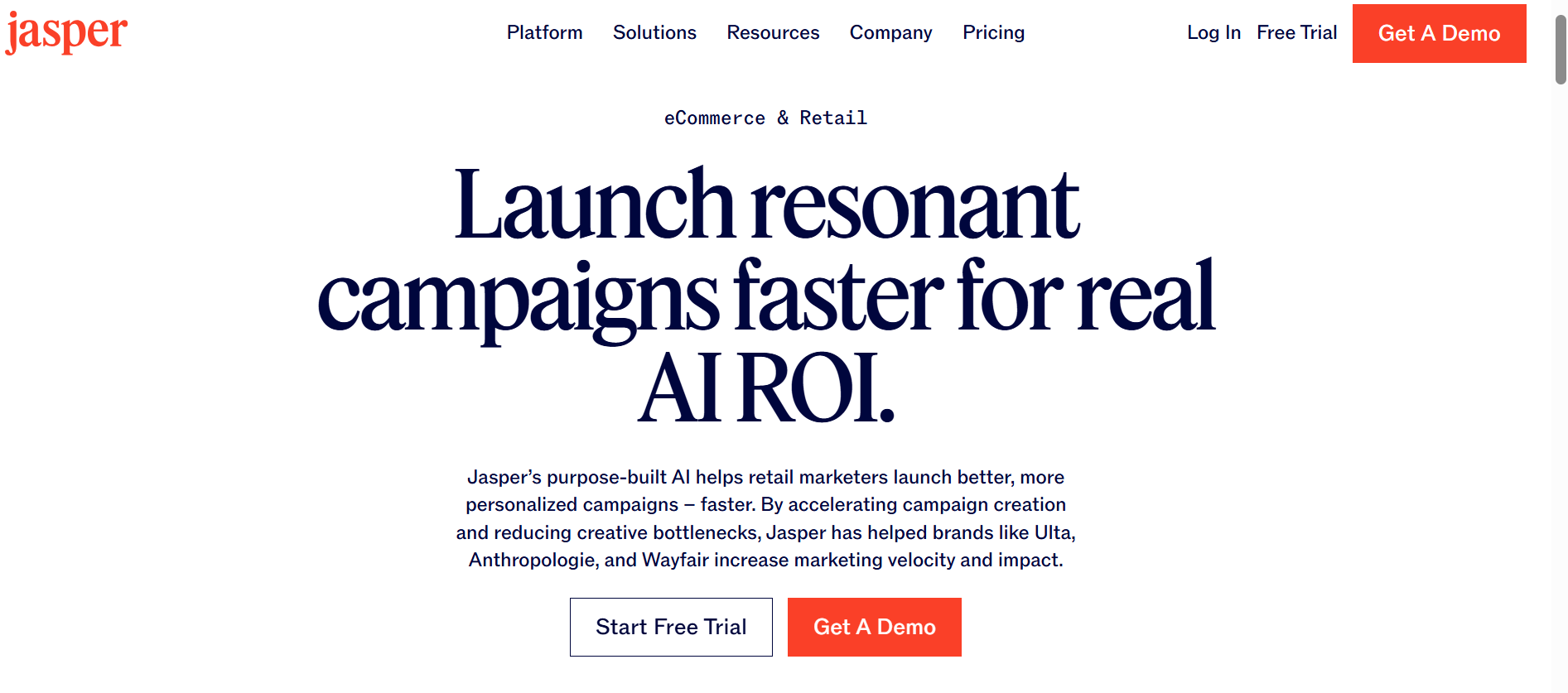
Jasper is an AI-powered tool for retail content creation and automation that lets marketers and brands write content in their unique voice, tone, and style across multiple channels. This tool helps teams reduce writing costs and write better copy faster.
Jasper equips brands with built-in templates for use cases like product copy, blog posts, and ad copy. It allows brands to automate content calendar workflows, publish to CMS, and optimize for SEO.
3. Clerk.io
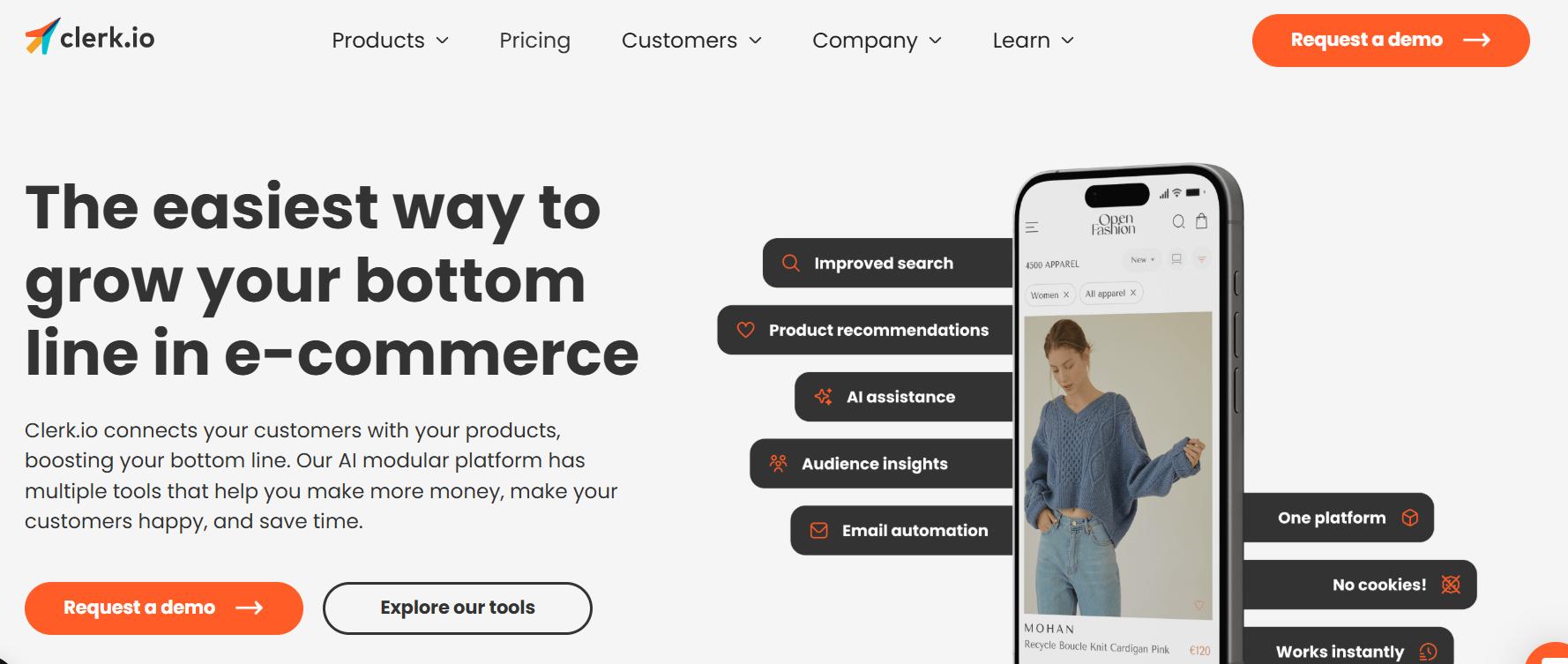
Clerk.io is an AI modular platform designed particularly for e-commerce businesses to help them make more sales. This AI tool allows businesses to add features like AI-powered search, assistance, email automation, and audience insights.
Clerk’s advanced search features enable customers to easily find their desired products. It also provides personalized recommendations based on customer data to increase upsells. Clerk also provides an AI-powered chatbot agent that offers instant customer support 24/7.
4. Octane AI
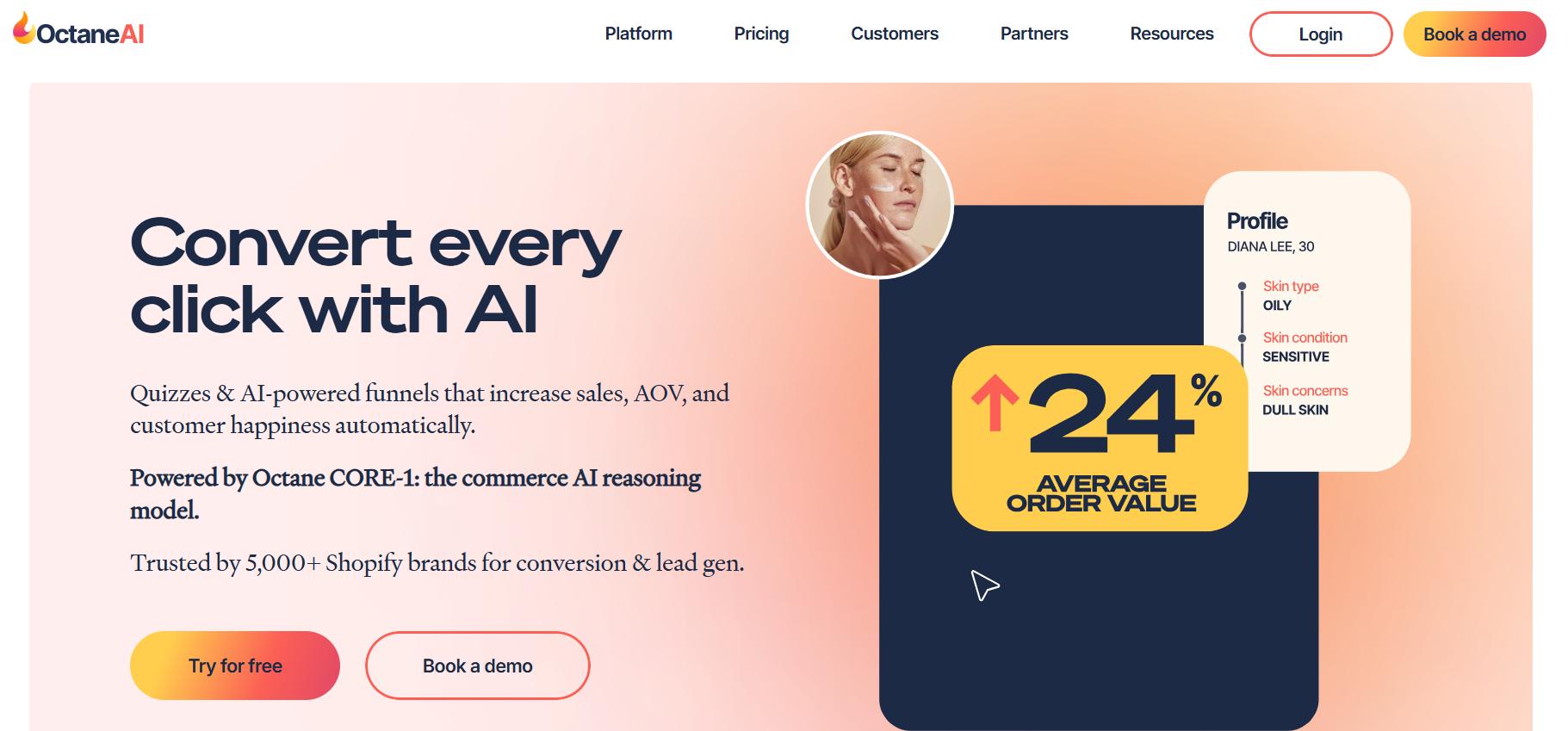
Octane AI allows brands to create AI-powered interactive quizzes to collect zero-party data from customers. This is a Shopify Plus Certified, Shopify native app that lets you build quiz flows using simple prompts. Octane’s Smart Code Builder also allows you to generate pixel-perfect HTML/CSS/JS pages matching your storefront. You can also include personalized sales copy and product recommendations on your websites powered by Octane CORE-1. You can also test different variations of your funnel and improve with the help of Octane AI.
5. Vue.ai
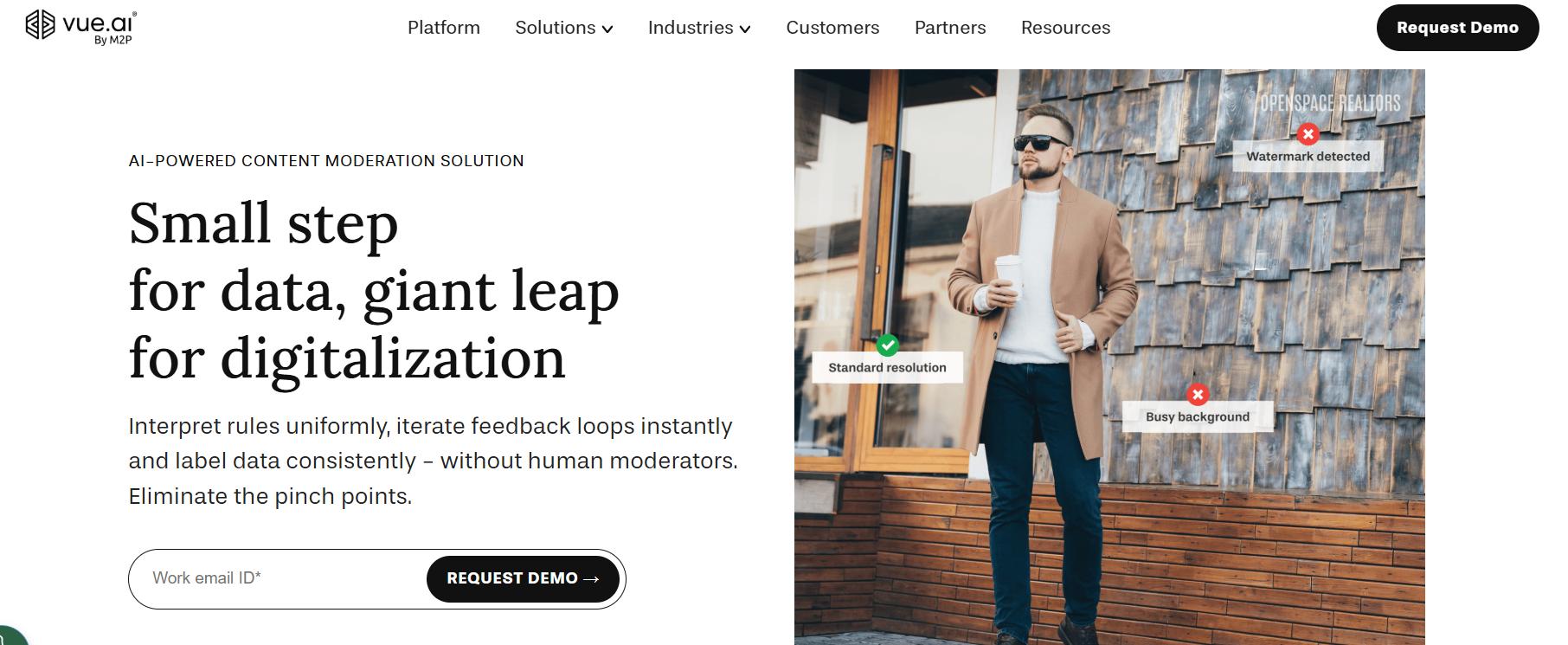
Vue.ai uses features such as image recognition and computer vision to help businesses create tailored workflows across industries, including food delivery, insurance, e-commerce marketplaces, health, and wealth. This AI tool is used for content detection, model training, and content moderation. Vue.ai also offers specific e-commerce features. It allows e-commerce brands to connect all their data sources, improve content, and deliver personalized experiences to customers.
How Tolstoy AI Commerce Platform Drives Personalized E-Commerce Experiences
Tolstoy’s AI Commerce Platform brings personalized shopping directly into the customer journey through AI Sales Agent — Tolstoy’s on-site sales assistant. AI Sales Agent combines virtual try-on, accurate sizing recommendations, and smart product suggestions to give every shopper a tailored, confidence-boosting experience.
This personalized assistance lives not only on the website pages but also inside Tolstoy’s video feed, where shoppers browse shoppable videos and can instantly engage with the AI chat to ask questions, get recommendations, and move toward purchase — all without leaving the content experience.
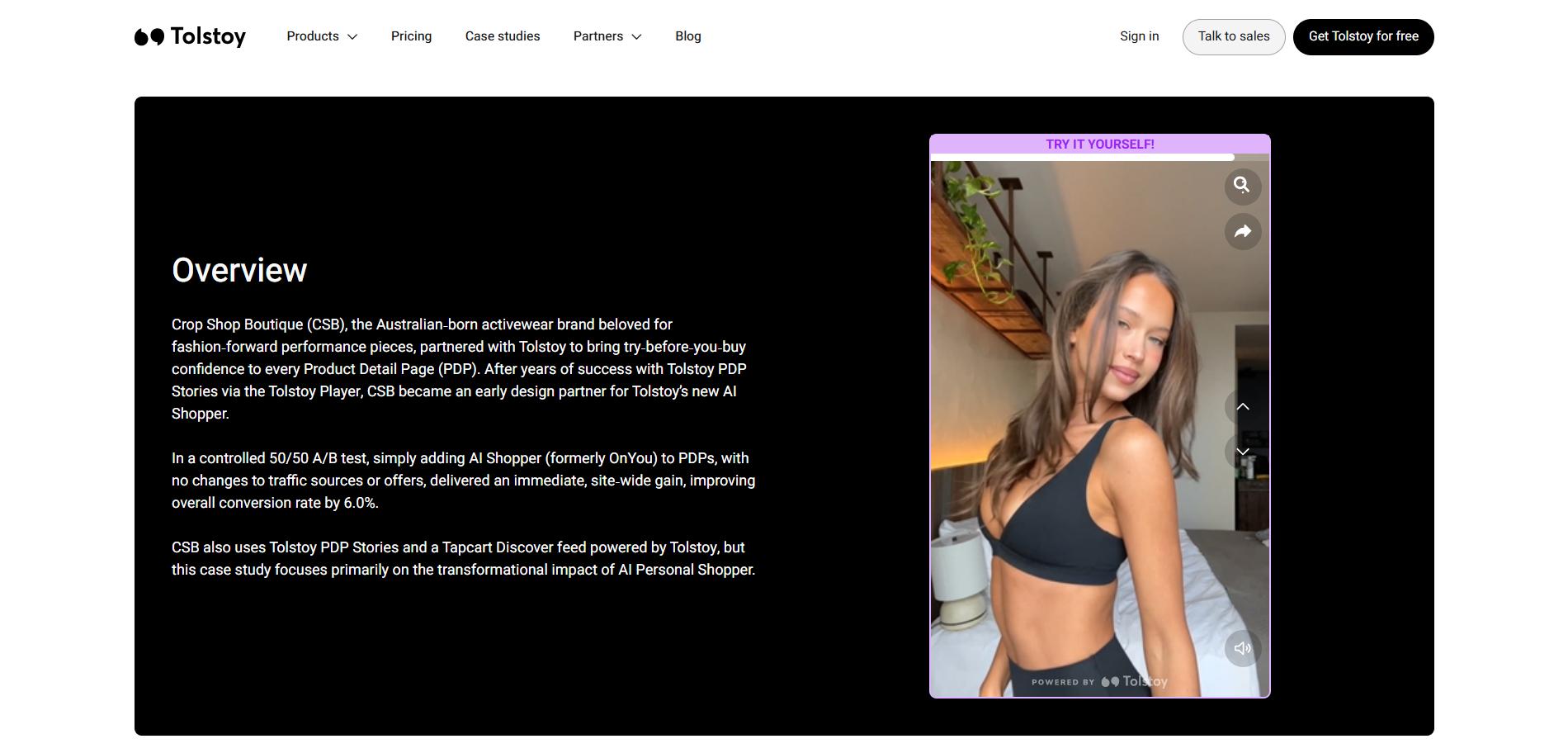
Brands are already seeing the impact. Crop Shop Boutique reported a 6% sitewide conversion uplift after enabling Tolstoy’s virtual try-on and AI sales chat, demonstrating how personalized, intelligent guidance can influence purchase decisions across the entire funnel.
Together, Tolstoy’s AI Sales Agent and interactive video experiences give e-commerce teams a unified, plug-and-play path to deliver personalized shopping at scale — without building custom infrastructure.
Another brand, Pantynova, converted social engagement into website sales by delivering a social-media-style shopping experience via Tolstoy’s shoppable videos, successfully bridging the gap between social interest and direct e-commerce.

To see which AI commerce use case fits your store first, book a free AI Studio demo.
Conclusion
AI-powered e-commerce tools are no longer a luxury - they’re a strategic advantage for brands aiming to scale, personalize customer experiences, and stay competitive. Whether it’s automated content creation, personalized product recommendations, or interactive shoppable videos, these solutions help brands serve their customers smarter and faster. That said, the real key lies in picking the right tool for the right role: by clearly identifying your business challenges (e.g., poor conversion, low engagement, content bottlenecks) and matching them with an AI tool that addresses them directly, you can maximize ROI while minimizing complexity.
With platforms like Tolstoy, which bundle video commerce, AI-generated content, and conversational shopping in one interface, brands can connect discovery, engagement, and purchase without stitching together as many point solutions. The practical advantage in 2026 is not “using more AI.” It is shortening one measurable workflow while keeping product data, brand review, and customer experience under control.
Frequently asked questions
What is the best AI tool for ecommerce automation?
It depends on the job: Tolstoy leads for AI-generated product content, shoppable video, and on-site AI shopping assistants; Klaviyo for marketing automation; Gorgias for support. Most stores combine one content or conversion platform with one marketing and one support tool rather than a single all-in-one product.
How can I use AI to automate my ecommerce store?
Start with the highest-leverage loops: generate product images and videos with AI, add an AI shopping assistant to answer pre-purchase questions, automate email and ad creative refreshes, and use AI analytics to spot winning products. Automate one workflow at a time and measure conversion impact before expanding.
How can e-commerce brands use AI to personalize the customer journey?
E-commerce brands test, monitor, and track data using AI to personalize the customer journey. Track and monitor customer data to predict customer behavior Run A/B tests to see which personalization effort leaves a high impact Use customers’ past data to deploy retargeting campaigns
What makes Tolstoy different from other e-commerce AI tools?
Tolstoy merges three important tools required by most commerce businesses into one platform. AI Player for adding shoppable videos AI Studio for creating AI product videos and images AI Sales Agent for creating a personalized experience on site with a sales chatbot and virtual try-on.
How do Shoppable videos from Tolstoy improve conversions and engagement?
Tolstoy’s shoppable videos are more engaging than static images or regular videos. Bring the social media experience with a swipeable feed into your store Allows shoppers to discover new products in an engaging way Provides the confidence required to purchase through social proof.
What are the common mistakes brands make when implementing e-commerce AI tools?
E-commerce AI tools pose some challenges, too. Brands need to be careful about mistakes such as: Not relying on accurate, high-quality data Eliminating human intervention on AI decisions entirely Overcomplicating interfaces with unnecessary AI personalizations
Create with Tolstoy
Put these ideas into practice
Turn your product ideas into AI images, videos, and shopping experiences.