Hook testing at volume
A paid-social test needs many openings, not many finished films. Generate ten hooks on the same product, run them, and keep the two that hold attention.
Tolstoy for UGC-led commerce
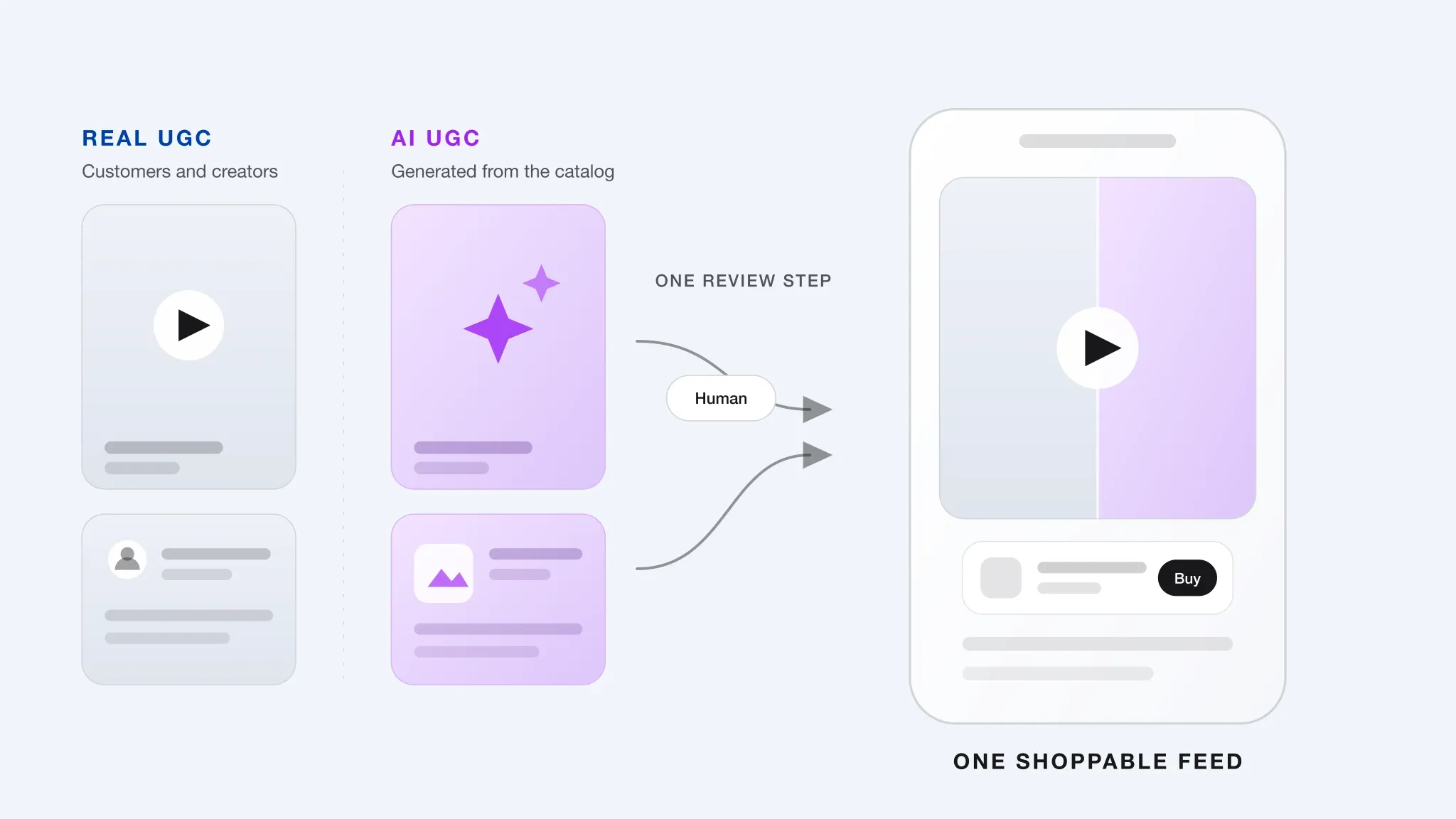
Use AI UGC for ad hook testing, creative volume, and SKU coverage. Use real UGC for trust on product pages. The best results are hybrid: real footage as the truth layer, generated video for the variants and the long tail around it.
AI UGC is user-generated-content-style video made with generative AI instead of a real customer or creator. A script, a product image, and an AI actor or scene produce a casual, phone-shot look. "UGC" here describes the style, not the source.
That distinction decides where the format belongs. Real UGC earns its effect because a person used the product; AI UGC borrows the look of that moment without the evidence behind it. Both are useful, and they are useful in different places. For the wider format, see UGC in ecommerce.
The two formats look alike in a feed and behave differently in a funnel. These are the axes that decide which one a given asset should be.
| Criterion | Real UGC | AI UGC |
|---|---|---|
| Speed to first asset | Bounded by finding the creator, shipping the product, and waiting for the post. | Bounded by having a product image and a script. |
| Cost shape | Per creator and per brief: gifting, fees, usage rights, and reshoots. | Per generation, inside a subscription or credit pool. |
| Trust signal | A real buyer or creator with a real experience of the product. | A production style. It carries no evidence that anyone used the product. |
| Funnel stage that fits | Consideration and decision: product pages, reviews, retargeting. | Discovery and testing: paid social hooks, variants, coverage. |
| Fit with high AOV | Stronger. A costly decision needs proof from a person. | Weaker on its own. Use it to attract attention, not to close. |
| Rights | Needs written permission per asset, per channel, and per period. | Set by the vendor licence and by the actor or avatar terms. Read both. |
| Product accuracy | Shows the physical product, with its real colour, scale, and packaging. | A reconstruction. Logos, proportions, and variants can drift. |
| Failure mode | The pipeline runs dry, or the footage is unusable for the channel. | Volume with no trust: a wrong product detail, or a scripted claim you cannot support. |
Each of these is a volume or coverage problem, which is what generation is good at.
A paid-social test needs many openings, not many finished films. Generate ten hooks on the same product, run them, and keep the two that hold attention.
Most catalogs have a long tail that no creator ever filmed. Generation reaches those products through the same process the hero products use.
One approved script can be reproduced in other languages and settings without booking a creator in each market.
A new or long-tail product page can get UGC-style motion from the catalog image while real creator content is still in production.
Structure matters more than volume here. How to structure UGC ads covers the hook, demonstration, and proof pattern that generated variants should follow.
Each of these is a trust problem, and trust does not scale through generation.
A shopper on a product page is looking for evidence. A real customer video is evidence; a generated one is art direction.
The higher the price, the more the shopper weighs who is speaking. Keep real people on the assets that carry the decision.
Texture, drape, scale, assembly, and how a product behaves in a hand are what shoppers ask about. Capture beats reconstruction here.
Organic feeds reward a creator relationship and a real account. Generated video posted as if it were a customer is the fastest way to lose both.
If the gap is collecting and publishing real customer video, start with the app comparison and the category breakdown.
One pipeline, two sources. Real footage sets the truth; generation covers everything the truth layer cannot reach in time.
Collect real footage of the product — customer clips, creator posts, and your own capture. This is the reference every generated asset is measured against.
Produce hooks, formats, languages, and long-tail SKU coverage from the catalog, keeping one saved creative direction so assets look like the same brand.
A person compares each generated asset with the real product before it is used anywhere. Logos, proportions, variants, and claims are the gate.
Run generated hooks where the cost of a weak asset is media spend, and read thumbstop, hold rate, and CTR before anything is promoted.
Put the assets that earned attention onsite, next to the real customer video, so the same feed carries both proof and coverage.
AI Studio generates UGC-style product video from your connected catalog. A person reviews every asset against the real product. AI Player publishes what passes — beside real customer and creator video — as shoppable video on the storefront.
Tolstoy is an AI ecommerce platform that publishes real UGC as shoppable video and generates AI UGC-style product videos from your catalog.
Entry prices are as listed on each vendor's own pricing page, checked Oct 2026. A vendor that publishes no price keeps a link instead of a number. Prices and features change — check the vendor page before you buy.
| Tool | Best for | Entry price | URL to video | Product in hand | Publishes to storefront |
|---|---|---|---|---|---|
| Creatify | Turning a product URL into ad variants with a large actor library. | $15/mo Standard ($12/mo billed annually) | Listed | Not listed | No — export |
| Arcads | Actor-led ad creative and batch variant production. | See vendor pricing | Not listed | Listed (product video generator) | No — export |
| HeyGen | Avatars and localization — the vendor lists 175+ languages and dialects. | Free tier; Creator $29/mo ($24/mo billed annually) | Not listed | Not listed | No — export |
| MakeUGC | Product-in-hand and avatar-led AI UGC ads at batch volume. | Starter $29/mo billed yearly | Not listed | Listed | No — export |
| Captions | Mobile-first editing with AI actors and digital twins. | Free tier; Max $24.99/mo (iOS plans) | Not listed | Not listed | No — export |
| Tolstoy | Publishing real UGC as shoppable video, and generating UGC-style product video for SKUs with no footage. | Starter $12/mo ($8/mo billed annually) | Not listed | No — not an actor-library tool | Yes — AI Player onsite |
To be plain about where we sit: Tolstoy is not an actor-library or avatar ad tool. If you need a thousand AI actors reading a script, the specialists above do that better. Tolstoy's job is the feed on your storefront — real UGC where trust matters, generated product video where coverage matters. For the head-to-head, see Tolstoy vs MakeUGC.
Generated from product inputs, reviewed before use. Open one to see the full asset.
Run this before a generated asset is attached to a SKU. It is five checks, and it is the difference between coverage and a returns problem.
The full gate — pass, review, and reject lanes — is in garment-fidelity QA before the PDP.
Check the mark, its spelling, and its placement on the product. A redrawn logo is the defect shoppers notice first.
Compare the product against the hand, body, or surface beside it. A bottle that reads as twice its real size creates a return.
Confirm the exact colourway, size, finish, and set contents match the SKU the asset is attached to.
Every spoken or captioned claim needs the same substantiation as the claim on the product page. Generated speech is still advertising.
An AI person must never be presented as a named customer, and must never deliver a testimonial about using the product.
Two separate obligations: the platform wants a label, and the advertising regulator wants the content to be true. Meeting one does not meet the other.
The FTC's Consumer Reviews and Testimonials Rule (16 CFR Part 465) bans fake or false reviews and testimonials, including ones from a reviewer who does not exist. The FTC's own guidance states there is "no blanket prohibition on the use of AI-generated avatars in marketing" — and that it would violate the rule to make an avatar speak favourably about a product in a way that reasonable consumers would read as a real testimonial.
FTC final rule announcement · FTC rule Q&A · FTC Endorsement Guides
TikTok's Community Guidelines state that it requires creators to label AI-generated or significantly edited content that shows realistic-looking scenes or people, and that unlabelled content may be removed, restricted, or labelled by its team.
Meta adds an "AI info" label to video, audio, and image content, applied from industry-standard AI signals and from the poster's own disclosure when they upload AI-generated content.
Meta Transparency Center — labeling AI content · Meta's approach to labeling
The operating rule is short: never fabricate a testimonial, and never present an AI person as a real customer. Generated video may show the product. It may not claim to be someone's experience of it.
Read these per variant, on your own account. We publish no benchmark numbers, because a benchmark from another catalog tells you nothing about yours.
Share of impressions that keep watching past the first seconds. This is what a generated hook is for, so read it first.
Share of viewers still watching at the middle and end of the asset. A strong hook with a weak hold means the script, not the opening, needs work.
Whether attention turns into a visit. Compare it between variants of the same product, not across products.
Whether the visit turns into an order. Generated creative usually earns traffic before it earns conversion, so judge it on the whole path.
The real unit cost: subscription and credits, plus the review time each asset needs before it may run. Tools that need more review are not cheaper.
Agent-driven workflows change what is cheap to produce and what still needs a person — AI agents and UGC in ecommerce covers that shift. For catalog-wide production of the underlying product content, see AI catalog production at scale.
AI UGC is user-generated-content-style video made with generative AI instead of a real customer or creator. A script, a product image, and an AI actor or scene produce the casual, phone-shot look of a creator post. The term describes the production style, not the source of the content.
It is worth it where the constraint is volume or coverage: ad hooks to test, languages to reach, and products no creator has filmed. It is not a replacement for real customer video on the pages where a shopper is looking for proof. Most stores get the best result from both.
That depends on the vendor licence and on the actor or avatar terms, which are separate documents at most tools. Read both before a campaign, and keep the generated asset and its licence together so the rights are provable later.
The platforms require a label. TikTok states that it requires creators to label AI-generated or significantly edited content that shows realistic-looking scenes or people. Meta applies an "AI info" label on Facebook and Instagram, from its own detection and from the poster's own disclosure. Separately, US advertising law does not permit a fake testimonial, whatever label is on it.
Generated product video can sit on a product page as product content — a demonstration of the item, reviewed against the real product first. What must not go there is a generated person presented as a customer review or testimonial. Keep the social-proof slot for real people.
It depends on the job. For actor-led ad volume, the specialist generators in the table above are built for exactly that. For getting reviewed video onto the storefront — real customer content and generated product video in the same feed — judge tools on catalog context, review controls, and whether approved assets have a route onsite at all.
We publish no conversion benchmark here, because the honest answer depends on your product, price, and placement. The reliable rule is structural: generated video is strongest where attention is bought and tested, and real video is strongest where trust is being asked for. Test both on your own catalog and read the metrics in the section above.
Publish the customer video you already have, generate what the catalog is missing, and keep a person between generation and the storefront.