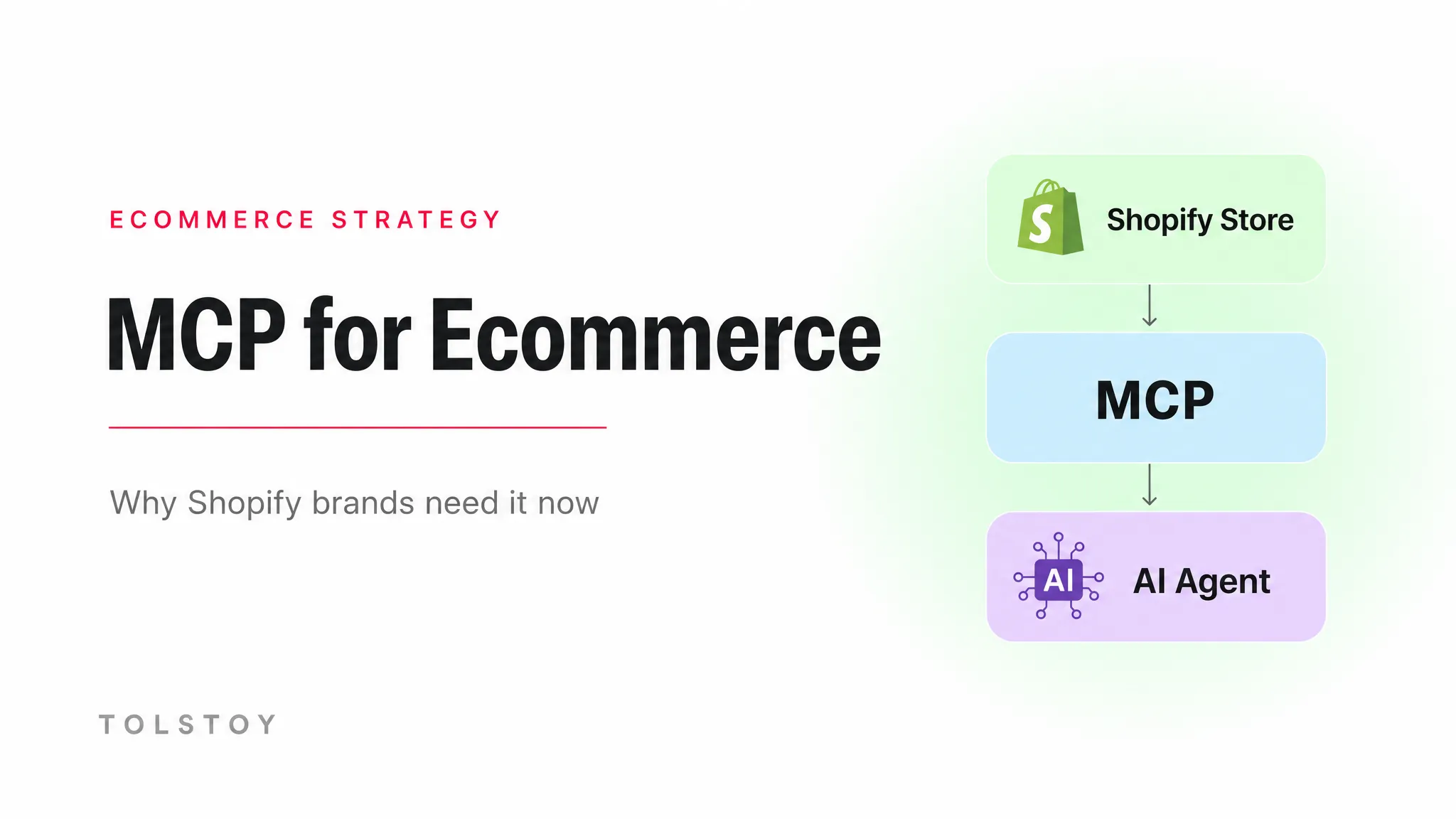
MCP is the reason AI agents can move from "good suggestion" to "go do it."
For ecommerce teams, that difference matters. A generic AI assistant can write product copy or brainstorm a campaign. An MCP-connected agent can work with the tools and content systems behind the campaign.
That is why Model Context Protocol is becoming important for Shopify brands, not just developers. Commerce moves through product data, creative assets, storefronts, media libraries, ads, email, SMS, analytics, and customer conversations. If AI agents cannot reach those systems, they stay stuck at the idea stage.
Quick definition: MCP, or Model Context Protocol, is an open standard that lets AI applications connect to external tools, data, and workflows through a common protocol.
In plain English: MCP gives agents a safer, more structured way to use the software your team already depends on.
What Is MCP?
MCP stands for Model Context Protocol. It gives AI applications a standard way to connect to external systems.
Those systems can be simple, like a folder of files, or complex, like a commerce platform, CMS, product catalog, creative tool, database, or media library.
Before MCP, every AI product needed a custom integration for every system it wanted to use. One integration for a file tool. Another for analytics. Another for a CMS. Another for product data. That approach becomes messy fast.
MCP changes the pattern. A tool can expose an MCP server. AI clients that support MCP can then discover what that server offers and call approved tools in a consistent way.
The important part is not the acronym. The important part is access. MCP gives AI agents a path into real systems, with clearer boundaries than a pile of one-off integrations.
For a deeper implementation comparison, read Shopify AI Toolkit vs. MCP to understand how commerce teams should think about platform tradeoffs.
Why MCP Is Becoming Necessary For Software
Software used to compete mostly on the human interface: better dashboards, cleaner workflows, faster buttons.
That still matters. But AI adds a second interface: the agent interface.
Increasingly, users will not open every app manually. They will ask an agent to prepare a launch, find assets, generate creative, summarize performance, update a workspace, or build campaign variants.
If the agent cannot reach a tool, that tool becomes invisible in the workflow.
The new software question: Can a person use this tool easily, and can an agent use it safely on behalf of the team?
That is why MCP is moving from technical curiosity to product requirement. It is becoming one of the main ways tools make themselves available to AI-native work.
Why Ecommerce And Shopify Brands Should Care
Ecommerce is context-heavy. A Shopify brand has product data, inventory, PDP content, videos, images, reviews, campaigns, discount rules, creative variants, audience insights, and performance signals spread across multiple tools.
AI is only useful when it can work with that actual context.
Without MCP, an agent might say, "You should create more product videos for this collection." Helpful, maybe. But still generic.
With MCP-ready tools, the agent can participate in the workflow behind that recommendation:
- Find the relevant product or collection context.
- Use approved creative tools to generate product-specific assets.
- Organize the output in the right media library.
- Prepare assets for PDPs, ads, email, SMS, or landing pages.
- Help the team create variants without restarting from scratch.
That is the practical value. MCP is not about making ecommerce more technical. It is about removing the gap between an AI idea and the systems needed to execute it.
MCP Vs Traditional Ecommerce Integrations
Traditional integrations usually connect one tool to another through a fixed path: Shopify to an email platform, a product feed to an ad platform, a video app to a PDP, a CMS to a storefront.
Those integrations are still useful. MCP does not replace them.
The difference is that MCP is designed for agent workflows. It lets an AI application discover available tools, request the right context, and use approved actions based on the task.
That flexibility matters because ecommerce work is rarely a straight line. A launch might require product content, creator-style videos, refreshed PDP assets, campaign copy, library organization, and follow-up variants. A fixed sync does not cover that. An agent workflow can.
Where Tolstoy MCP Fits
Tolstoy MCP is focused on the commerce content layer.
Today, Tolstoy exposes AI Studio content creation and media-library management to AI agents through MCP.
That matters because content is one of the biggest bottlenecks for Shopify brands. Teams need new product images, product videos, variants for ads, visuals for PDPs, assets for email and SMS, and organized media that can be reused later.
Tolstoy already brings AI-powered content and shopping experiences into one platform:
- AI Studio: create product photos and videos from a prompt.
- AI Player: bring shoppable video to PDPs, landing pages, email, SMS, and other commerce surfaces.
- AI Sales Agent: help shoppers discover products, ask questions, use virtual try-on, and move toward checkout.
MCP makes the AI Studio and media-library pieces available to the agents teams are already starting to use.
When you are ready to try the workflow directly, follow the guide to connect Tolstoy MCP to ChatGPT, Claude, Cursor, or Codex.
If you want to see how MCP connects to real content creation workflows, book a free AI Studio demo.
Example: A Faster Shopify Launch Workflow
Say a Shopify brand is launching a new collection.
Without MCP, the team might ask AI for campaign ideas, then manually move between creative tools, product files, exports, uploads, media organization, and channel prep.
With Tolstoy MCP, an agent can help closer to the actual work:
- Start from the collection brief or product context.
- Generate product visuals in Tolstoy AI Studio.
- Organize the new assets in the media library.
- Prepare content for the next PDP, ad, email, or SMS workflow.
- Create variants when the team needs more angles, formats, or product moments.
The brand still decides what ships. MCP is not a replacement for taste, strategy, or approval. It is a way to make the agent useful inside the workflow instead of adjacent to it.
How To Evaluate MCP Tools For Ecommerce
Not every MCP implementation is equally valuable. When evaluating MCP-ready commerce tools, ask practical questions:
- What can the agent actually do?Look for specific tools and actions, not vague "AI-ready" language.
- What context can it access?For ecommerce, product, content, media, and channel context matter.
- How are permissions handled?The agent should only use approved capabilities.
- Does it map to revenue work?The best MCP tools help teams create, organize, launch, measure, or improve work that affects the storefront.
For Tolstoy, the first practical use case is clear: connect agents to AI Studio content creation and media-library management so ecommerce teams can move faster from idea to usable product content.
The Bottom Line
MCP is not just another AI acronym. It is part of the infrastructure that lets agents work with real tools.
For Shopify brands, that matters because commerce execution depends on context: products, creative, media, channels, shoppers, and performance. The brands that benefit most from AI will be the ones whose tools are accessible to agents, not locked away in disconnected tabs.
Tolstoy MCP brings that agent-ready layer to AI Studio content creation and media-library management. If content is the bottleneck, MCP is how the agent starts helping where the work actually happens.
For more on the broader stack, read our guide to ecommerce AI tools. For where this content can drive revenue on-site, see how shoppable AI videos for Shopify improve storefront performance.
FAQs
What does MCP stand for?
MCP stands for Model Context Protocol. It is an open standard that lets AI applications connect to external tools, data sources, and workflows.
What is MCP in simple terms?
MCP is a standard connection layer for AI agents. It helps an agent discover what a tool can do, access approved context, and call approved actions.
Why is MCP important for ecommerce?
Ecommerce teams work across product catalogs, creative assets, storefronts, ads, email, SMS, analytics, and support. MCP makes those tools more accessible to AI agents, so the agent can help with real workflows instead of only giving generic advice.
Why do Shopify brands need MCP?
Shopify brands need constant product content, creative variants, merchandising updates, and campaign assets. MCP-ready tools make it easier for agents to help create, organize, and prepare that work.
What does Tolstoy MCP do?
Tolstoy MCP connects AI agents to Tolstoy AI Studio content creation and media-library management, so ecommerce teams can generate and organize commerce content through agent workflows.
Is MCP the same as an API?
No. APIs let software systems exchange data or trigger actions. MCP is designed for AI applications, giving agents a standard way to discover tools, understand context, and use approved capabilities.
Create with Tolstoy
Put these ideas into practice
Turn your product ideas into AI images, videos, and shopping experiences.