
Quick answer: Shopify is building an AI commerce operating system
Shopify’s 2026 AI strategy now covers the full commerce loop: run the business with an assistant, create and edit the store with prompts, distribute products into AI channels, help shoppers buy through conversations, test storefront changes with simulated shoppers, and give developers an agent-ready platform.
- Agentic Storefronts, Shopify Catalog, and UCP put product discovery and checkout into AI conversations.
- Sidekick is becoming the conversational control layer for Shopify admin work and connected apps.
- Shopify Magic brings AI generation into product copy, images, email, themes, and theme blocks.
- SimGym, Rollouts, search, and Shopify Inbox apply AI to storefront testing and shopping assistance.
- Shop and personal-agent integrations give buyers new conversational ways to discover products.
- Catalog API, MCP, UCP, and Shopify AI Toolkit make the platform easier for agents and developers to extend.
The practical takeaway for brands is clear. Shopify is building the infrastructure. Merchants still need accurate product context, distinctive creative, brand review, useful onsite experiences, and a measurement loop. That is the layer where Tolstoy fits.
Shopify’s AI strategy at a glance
Use this map to separate Shopify’s platform work from the operating work your team still owns.
| Initiative | What Shopify provides | What the brand still owns | Where Tolstoy helps |
|---|---|---|---|
| Agentic Storefronts, Catalog, and UCP | Structured product discovery and commerce across AI channels | Complete product data, differentiated stories, accurate claims, and a strong landing experience | AI-generated product content, shoppable media, and onsite guidance after discovery |
| Sidekick | A store-aware assistant for Shopify admin tasks and supported apps | Priorities, approvals, brand judgment, and customer-facing execution | A conversational workflow for creating, reviewing, publishing, and measuring visual content |
| Shopify Magic | Text, media, theme, and theme-block generation inside Shopify | Product fidelity, creative direction, campaign variants, and cross-channel reuse | Brand-trained images, videos, ads, PDP assets, and bulk creative workflows |
| SimGym and storefront AI | Simulated theme analysis, assisted search, and conversational selling tools | Real-world testing, richer product education, and conversion decisions | Shoppable video, AI widgets, personalized media, and asset-level experimentation |
| Shop and personal agents | Conversational product discovery using Shop context | A consistent brand experience when the shopper reaches an owned surface | Onsite recommendations, product answers, UGC, video, and add-to-cart guidance |
| AI-native developer platform | Agent protocols, commerce APIs, MCP servers, and AI-assisted development | Useful customer workflows and connections beyond Shopify’s core data | MCP access to content, media, and shoppable-experience workflows |
1. Agentic Storefronts, Shopify Catalog, and UCP move commerce into AI channels
This is Shopify’s largest strategic move. The company is turning AI assistants into storefronts where shoppers can discover products, compare options, build a cart, and move toward checkout.

Shopify Agentic Storefronts lets merchants manage how eligible products appear across supported AI channels from the Shopify admin. Shopify’s 2026 announcements name ChatGPT, Microsoft Copilot, Google AI Mode, and Gemini among those surfaces, with availability depending on channel, region, product eligibility, and rollout status.
Three components make the system work:
- Shopify Catalog structures and enriches product data so agents can retrieve products by intent.
- Universal Commerce Protocol (UCP) defines how agents and merchants communicate across discovery, carts, checkout, and orders.
- Agentic Storefronts gives merchants a central place to manage channel participation and monitor AI-channel activity.
Shopify’s Spring ’26 developer update says UCP and Catalog API are now available as self-serve infrastructure for developers. That widens the field beyond a small group of approved partners.
What brands should do
Start with product truth. Clear titles, complete attributes, accurate variants, current price and inventory, comparison details, and consistent policies give agents better material to work with. Then review the experience a shopper reaches after the AI channel sends them to your store.
Catalog inclusion does not create differentiation by itself. Two products with similar structured data can still feel interchangeable to an assistant. Brands need content that explains use cases, demonstrates the product, answers objections, and gives the shopper a reason to choose.
Where Tolstoy fits
Tolstoy AI Studio helps teams create product-specific images, videos, ads, and PDP assets from catalog data and brand context. AI Player publishes approved video and UGC as shoppable storefront experiences. AI Sales Agent gives the visitor an onsite path to ask follow-up questions, get recommendations, and add products to cart.
Shopify handles distribution into AI channels. Tolstoy helps the brand make the product easier to understand, trust, and buy when the shopper reaches an owned experience.
2. Sidekick is becoming the merchant’s conversational control layer
Sidekick began as an assistant for questions and store tasks. In 2026, Shopify is pushing it toward a store-aware operating interface.

Shopify’s current Sidekick documentation shows the assistant filling forms, editing products and collections, preparing order changes for review, creating task lists, editing theme settings, and working with supported third-party apps. Shopify also introduced Sidekick Pulse, which researches store data and surfaces proactive recommendations when available.
Sidekick App Extensions matter for the ecosystem. Supported apps can expose data or actions inside a Sidekick conversation, so a merchant can ask a question without opening every app separately. Shopify’s Spring ’26 release moved those extensions from preview into the wider developer ecosystem.
What brands should do
Treat Sidekick as an execution interface with human approval, not as the owner of strategy. Give it narrow jobs with clear inputs:
- find the products missing key fields before an AI-channel launch;
- prepare a collection or discount for review;
- summarize store data before a merchandising decision;
- stage a theme change, then inspect it on desktop and mobile;
- pull context from supported apps without switching tabs.
The merchant still decides what deserves attention, what is safe to publish, and how the work should sound and look.
Where Tolstoy fits
Sidekick operates the Shopify business layer. Tolstoy operates the visual-content and shoppable-experience layer. In AI Studio, a team can connect catalog data, Brand DNA, approved references, and campaign files; generate assets; review or regenerate them; and publish approved work into ecommerce surfaces.
That separation is useful. Sidekick can help identify the business task. Tolstoy gives creative, ecommerce, and agency teams a focused place to execute the customer-facing content and experience.
3. Shopify Magic makes generation native to everyday commerce work
Shopify Magic is the umbrella for AI features embedded across Shopify. It can generate suggestions for product descriptions, pages, blog posts, email subject lines, Shopify Inbox replies, and theme copy. It also supports media editing, free personalized theme generation, and prompt-generated theme blocks.
This lowers the starting cost of routine creation. A merchant can remove an image background, draft a description, generate a hero banner, or ask for a custom Liquid block without leaving Shopify.

Shopify’s own guidance includes the correct warning: the merchant remains responsible for accuracy. Generated product copy can invent a benefit or reuse a fact that applies to a similar product. Generated theme blocks can create accessibility, performance, or code-quality issues. Review remains part of the workflow.
What brands should do
Use Shopify Magic for contained tasks that benefit from store context and stay easy to verify. Give each prompt the actual product details, intended customer, required claims, forbidden claims, brand terms, and channel.
For a skincare product, for example, the prompt should include the real ingredients, skin types, usage instructions, and approved claims. A generic request for “premium skincare copy” gives the model too much room to improvise.
Where Tolstoy fits
Shopify Magic is useful for one-off generation inside the admin. Tolstoy AI Studio is built for a broader creative production loop: reusable brand context, images and video, campaign variants, review, bulk generation, and publishing across PDPs, email, social, and ads.
For a consumer packaged goods team, that can mean turning an approved package shot into several realistic lifestyle scenes, a short product video, a PDP demonstration, and campaign variants while keeping packaging, ingredients, and claims under review. The goal is consistent output across the launch, not a folder of unrelated AI assets.
4. Shopify is applying AI to storefront testing, search, and selling
Shopify’s storefront AI work now goes beyond generation.
SimGym, currently labeled an AI Research Preview, sends simulated shoppers through a Liquid storefront. It can analyze one theme or compare a live theme with a draft, then return qualitative feedback and a simulated add-to-cart comparison. Shopify explicitly notes that simulated behavior can differ from real buyers and that Hydrogen and headless storefronts are not supported in the preview.

Shopify’s Spring ’26 Edition also highlights improved storefront search, an AI sales associate in Shopify Inbox, and Rollouts for scheduling and A/B testing theme or checkout changes. Together, these features point to a new workflow: generate a storefront idea, inspect it with AI, stage it, and validate it with real traffic.
What brands should do
Use simulated feedback to find hypotheses, then use live customer behavior to decide. A simulated shopper can reveal confusing navigation, weak product context, or a broken path to cart. It cannot establish incremental conversion or revenue.
Keep each test narrow. Change one major variable at a time, define the expected behavior before launch, and measure the downstream action that matters. For a PDP, that might be qualified add-to-cart rate or conversion, not video plays alone.
Where Tolstoy fits
Tolstoy AI Player adds shoppable video feeds, product stories, interactive media galleries, and custom PDP widgets to the storefront. Teams can connect product data, approved UGC, reviews, and brand context, then compare creative or placement variants based on real interactions.
SimGym can help identify where the storefront needs work. Tolstoy helps build and test the media or guided experience that addresses the issue. Live traffic still decides whether the change earns a wider rollout.
5. Shop is becoming a conversational shopping surface
Shopify is also building AI for the buyer. Its Spring ’26 Edition describes conversational discovery in the Shop app, with recommendations shaped by a shopper’s tastes and Shop history. Shopify is also opening Shop capabilities to supported personal AI agents so a shopper can discover products and approve purchases through an agent they already use.

This creates another entry point into the buying journey. A product may be discovered in Shop, an external AI assistant, a personal agent, or the brand’s own storefront. Product identity and policy accuracy need to remain consistent across all of them.
What brands should do
Map the questions that occur after discovery. A shopper who finds a supplement through an agent may still ask about routine, flavor, subscription terms, dietary fit, or delivery timing on the merchant site. A skincare shopper may want to compare ingredients or build a regimen. The product feed gets the item into consideration; the owned experience must help the buyer decide safely.
Where Tolstoy fits
Tolstoy AI Sales Agent gives the brand an onsite sales agent trained on catalog and brand context. It can answer product questions, recommend items, and support in-chat add-to-cart on the storefront. AI Player gives those answers a visual layer through product video, UGC, guides, and interactive PDP modules.
This is an owned complement to Shop and external AI channels. The conversation can continue on the brand’s site with its product context, creative, guardrails, and merchandising priorities.
6. Shopify is rebuilding its developer platform for agents
Shopify’s AI strategy also targets the people building commerce software.

The Spring ’26 developer release made UCP and Catalog API self-serve, opened Sidekick App Extensions to developers, and moved Shopify AI Toolkit to general availability. The toolkit gives supported coding agents access to Shopify reference material, store data, admin tools, skills, and CLI commands.
Shopify also provides UCP-compatible MCP servers for product discovery, carts, checkout, and order state. This turns the developer platform into something an AI agent can query and act through, instead of a documentation set a human must translate line by line.
What brands and agencies should do
Use the developer stack when the job truly needs custom software or agent access to commerce actions. A clear architecture separates three kinds of context:
- Commerce truth: products, variants, inventory, carts, checkout, orders, and policies.
- Brand truth: approved claims, tone, imagery, creative references, and audience context.
- Experience actions: create content, publish media, configure a widget, review performance, or launch a variant.
Shopify’s APIs and agent tools are strongest in the first layer. The second and third layers depend on the systems your team uses around Shopify.
Where Tolstoy fits
Tolstoy MCP connects supported AI clients to Tolstoy’s content, media, and shoppable-experience workflows. Shopify’s AI Toolkit helps an agent work correctly with Shopify. Tolstoy MCP gives that agent a path into customer-facing creative and visual-commerce work.
For a deeper technical comparison, read Shopify AI Toolkit vs. MCP for ecommerce teams.
What Shopify’s AI stack still leaves to brands
Shopify’s releases remove a large amount of infrastructure work. They do not remove five operating responsibilities.
- Product truth: complete, current, and specific product data.
- Creative differentiation: visual stories and demonstrations that give shoppers a reason to choose.
- Brand and claim review: a human decision about what is accurate and safe to publish.
- Owned conversion experience: useful product answers, recommendations, media, and cart paths on the brand’s site.
- Measurement: a test design that connects AI activity to qualified customer behavior.
This is especially visible in CPG. Food, beverage, beauty, skincare, wellness, supplement, and pet brands need more than generic product renders. They need correct packaging, believable use contexts, ingredient and claim discipline, product education, and enough variants to support launches without sending every request through a new production cycle.
For these teams, the winning workflow connects product truth to creative production, approval, publishing, shopper guidance, and learning.
How Tolstoy completes the Shopify AI workflow
Tolstoy brings four connected products to the work Shopify leaves closest to the customer:
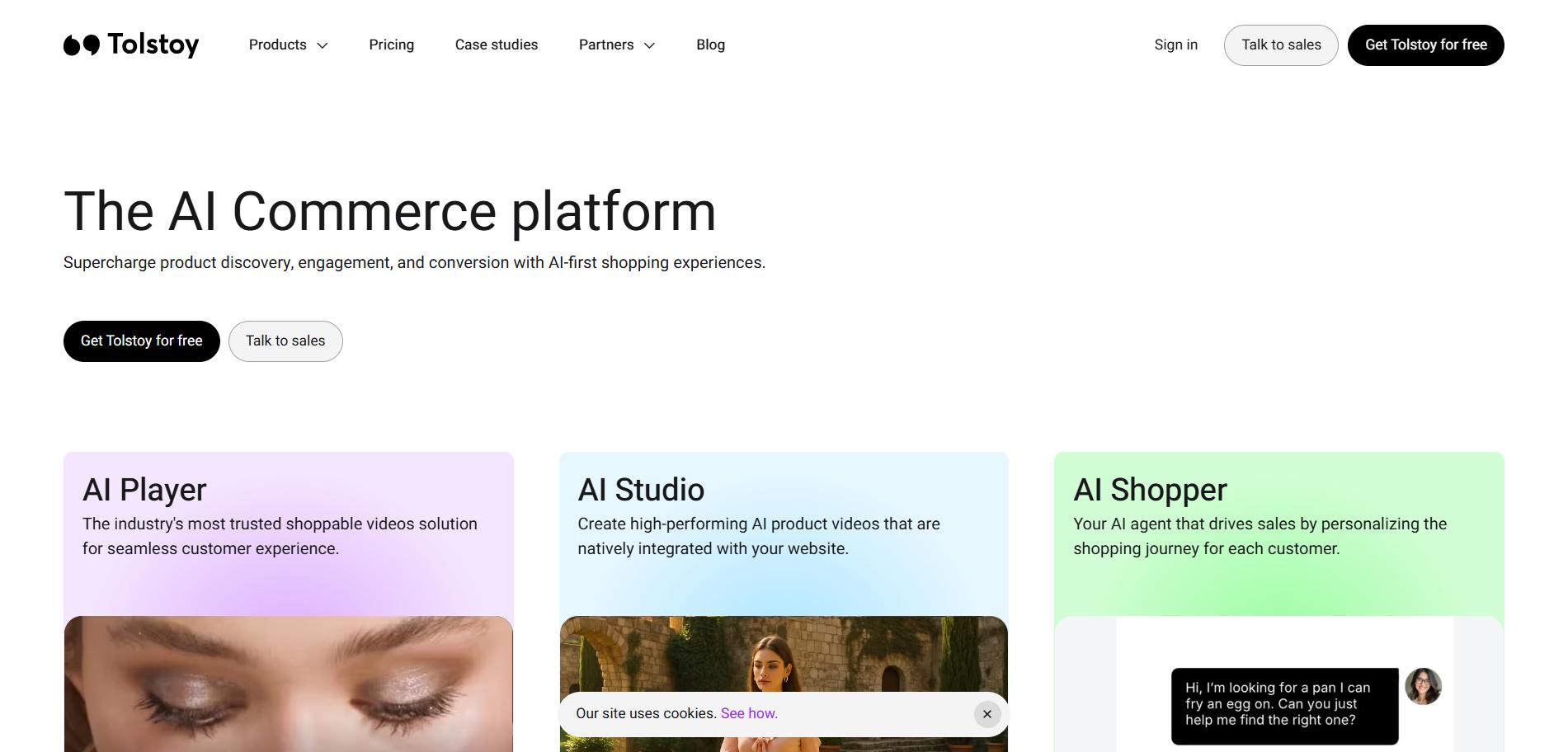
- AI Studio: create on-brand product images, videos, UGC-style assets, PDP content, and ad variants from catalog and brand context.
- AI Player: publish shoppable video, product stories, dynamic media galleries, and custom widgets across ecommerce surfaces.
- AI Sales Agent: answer questions, recommend products, and guide shoppers toward cart on the brand’s storefront.
- Tolstoy MCP: connect AI clients to approved content and shoppable-experience workflows.
The combined operating loop looks like this:
- Shopify supplies the catalog, transactions, admin context, and external AI-channel infrastructure.
- Tolstoy turns product and brand context into reviewable creative.
- Approved assets become shoppable media, PDP modules, ads, email content, and social variants.
- AI Sales Agent and AI Player help the visitor understand and act on the product.
- Real customer behavior informs the next creative or experience test.
That is a more useful definition of an AI commerce stack than a list of generators. Each layer has a clear job, and the brand keeps approval over what shoppers see.
A 90-day Shopify AI action plan
Days 1 to 30: audit the foundation
- Review Agentic Storefronts settings, channel availability, and product eligibility.
- Audit priority product titles, attributes, variants, availability, policies, and comparison context.
- List the top shopper questions for each priority category.
- Document approved brand references, product claims, and forbidden claims.
- Choose one business task for Sidekick and one customer-facing task for Tolstoy.
Days 31 to 60: build one complete journey
- Create a small set of reviewable visual variants for a priority product or collection.
- Publish one shoppable media or guided PDP experience.
- Pilot onsite product questions and recommendations on a bounded category.
- Connect the generated work to an actual campaign, PDP, or launch instead of leaving it in a concept folder.
- Run product, brand, mobile, accessibility, and claim review before traffic reaches it.
Days 61 to 90: test and learn
- Use SimGym or a structured review to find friction, treating simulated feedback as directional.
- Run a live test with one primary variable and one downstream success metric.
- Compare qualified product interactions, add-to-cart behavior, and conversion, not views alone.
- Feed real shopper questions back into product data, creative briefs, PDP content, and AI Sales Agent context.
- Scale only the workflow that survives product review and live customer evidence.
A Shopify AI strategy needs to connect infrastructure to customer experience
Shopify is making AI native to commerce operations, development, discovery, and checkout. That gives brands a strong foundation and removes a growing amount of integration work.
The competitive work moves closer to the customer: accurate context, distinctive product stories, fast creative iteration, useful onsite guidance, and disciplined testing. Tolstoy gives Shopify brands one connected place to create that content, publish it into shoppable experiences, guide buyers, and learn from what they do.
Want to turn Shopify’s AI infrastructure into customer-facing creative and shopping experiences? Start with Tolstoy for free.
Sources and status notes
This article reflects public product information available on August 5, 2026. Feature availability can vary by store, plan, market, channel, and preview status.
Frequently asked questions
What are Shopify’s main AI initiatives in 2026?
Shopify’s main AI initiatives include Agentic Storefronts, Shopify Catalog and UCP for AI-channel commerce; Sidekick for merchant operations; Shopify Magic for text, media, themes, and blocks; SimGym and Rollouts for storefront testing; conversational shopping in Shop and Shopify Inbox; and an AI-native developer stack built around Catalog API, MCP, and Shopify AI Toolkit.
What is the difference between Shopify Sidekick and Shopify Magic?
Shopify Magic is the umbrella for AI features such as text, media, theme, and theme-block generation. Sidekick is the conversational commerce assistant inside Shopify that uses store context to answer questions, prepare changes, and complete supported admin tasks with merchant review.
Are Shopify Agentic Storefronts the same as an onsite AI shopping assistant?
No. Agentic Storefronts distribute eligible product data and commerce capabilities to external AI channels. An onsite AI shopping assistant serves shoppers on the brand’s own storefront, where it can answer detailed questions, recommend products, and guide a visitor toward cart.
Does SimGym replace live A/B testing?
No. Shopify describes SimGym as an AI Research Preview whose simulated results can differ from real shopper behavior. It can help teams find issues and prioritize hypotheses, but live traffic and business outcomes are still needed to validate a change.
How does Tolstoy complement Shopify’s AI tools?
Shopify supplies the commerce infrastructure and native admin tools. Tolstoy adds a brand-trained creative and owned-experience layer: AI Studio creates product images, videos, ads, and PDP assets; AI Player publishes shoppable media and widgets; AI Sales Agent guides visitors on the storefront; and Tolstoy MCP connects those workflows to AI clients.
Create with Tolstoy
Put these ideas into practice
Turn your product ideas into AI images, videos, and shopping experiences.